
Matic on Novo Brdo: Coin minting has always been a royal privilege
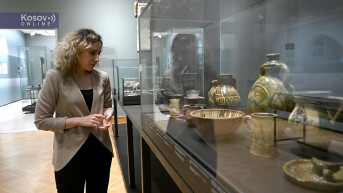
The Novo Brdo mine first appeared during the reign of King Milutin and quickly became one of the most significant mining centers, reaching its peak during the time of Despot Stefan. Glam silver was excavated there, containing a certain percentage of gold, making it a precious combination. It was during the time of Stefan Dusan, in the late first half of the 14th century, that the first coin mint was opened there, where the Serbian dinar was minted, Jana Matic, a curator at the National Museum, says presenting part of the museum's permanent exhibition dedicated to Novo Brdo.
As she points out, coin minting has always been a royal privilege or rather a "question of statehood and sovereignty." Serbia, like other European states, followed monetary developments and trends, and when the monetization of European society began in the late 12th and early 13th centuries, Serbia became involved in all of it.
"The first coinage of rulers from the Nemanjic dynasty is associated with King Radoslav, the son of Stefan the First-Crowned, who minted the first Serbian currency at Ras. These were trachy made of copper and silver, but after his reign, various political changes occurred, leading to a pause in coin minting. Coin minting resumed during the reign of King Dragutin, when the Serbian dinar entered circulation, now minted according to a completely new model, based on the Venetian grosso. What is characteristic of Serbian currency minted throughout the existence of the Serbian medieval state, up to the fall of the despotate, is that it was almost exclusively made of silver," Matic emphasizes.
According to her, Novo Brdo first emerged during the time of King Milutin. It quickly surpassed other highly developed mines in Serbia such as Brskovo and became one of the most significant mining centers already during the reign of Emperor Stefan Dusan, reaching its peak during the time of Despot Stefan.
"There, glam silver was excavated, containing a certain percentage of gold, which is indeed a precious combination. It was during the time of Stefan Dusan, in the late first half of the 14th century, that the first coin mint was opened there, where the Serbian dinar was minted, during the reigns of Stefan Dusan, Prince Lazar, later Despot Stefan, and Djurdje Brankovic. The development of mining in Serbia was greatly influenced by the Saxon miners, who significantly advanced mining production. Later, the local population also got involved, leading to a significant expansion of mining. This is vividly illustrated by the fact that in the 13th century, Serbia had 7 mines, but by the mid-15th century, there were over 30," Matic states.
She adds that during the despotate, this silver supplied significant quantities to the entire Europe, and Novo Brdo "did not without reason find its place on the world maps as one of the most significant mines in the Balkans." In addition to the mine, Novo Brdo also housed a coin mint. On the other hand, there were some smaller mining centers in Kosovo where ore was excavated, such as Gracanica or Janjevo, but the coins were minted in Pristina, Prizren, Pec, and Zvecan, with significant state control over this process.
"The coin minting and monetary policy were under strict state patronage; it was also a significant source of income and an indicator of statehood. Moreover, in an iconographic sense, it served as a channel of communication between rulers and subjects, allowing various messages to be conveyed, thus serving a propaganda role. Therefore, the state always sought to maintain control over coin minting. This is evident through Dusan's Code and later the significant Novo Brdo Code, or Despot Stefan's Law, also known as the Mining Code," Matic explains.
According to her, unfortunately, we know little today about how the mints functioned, but we can make assumptions based on how they operated in other countries.
"Mints in Serbia were mostly leased out, and the mint master had the crucial task of ensuring the quality of the currency, its weight, purity, and preventing counterfeiting, as strict penalties were imposed for that. The process involved several stages, from making molds to cutting the blanks and finally minting the coins. Mold cutters were among the most important members of the mint, often coming from other places like Thessaloniki, Dubrovnik, and other coastal cities, and we can recognize various influences based on some stylistic characteristics," our interlocutor explains.
The molds themselves, she emphasizes, consisted of two parts, one fixed and the other movable, which today would be equivalent to the obverse and reverse. Very few of these molds have been preserved because they were destroyed after use to prevent currency counterfeiting. Coins usually featured various depictions of rulers.
"Rulers were often depicted alongside Christ or saints, with the Virgin Mary, for example, in the first coinage of King Radoslav. On the obverse, there is Archangel Michael, while on the reverse, there are depictions of Christ blessing the king or, for example, the Virgin Mary, and even Emperor Constantine. For instance, during the reigns of King Dragutin and Milutin, Saint Stephen appears as the protector of the Nemanjic dynasty, and we see Saint Stephen on seals as well. Later, we have depictions of helmets, rulers with swords on horseback, a variety of representations, such as emperors and empresses if we are talking about Dusan and Helen," Matic says.
She recalls us that within the permanent exhibition of the National Museum, there is an entire room dedicated to Novo Brdo, featuring objects found during archaeological excavations, reconstructions of Novo Brdo at its peak in the 14th and 15th centuries, mining tools, ceramics found in the cathedral main church in Novo Brdo, as well as some old coins and jewelry, "because the development of mining conditioned the development of trade and craftsmanship, making Novo Brdo the largest Serbian medieval city."
However, even during the time of Despot Stefan, while Novo Brdo was at its peak, there were pressures from Ottoman conquests, and Novo Brdo fell under Ottoman rule for the first time in 1441. However, it was soon returned to Serbian control - unfortunately, not for long.
"In 1455, Novo Brdo fell, shortly followed by the Serbian capital, marking the end of the Serbian medieval state and the cessation of Serbian medieval coin minting in Novo Brdo. However, Novo Brdo retained a certain significance during the Ottoman period, but the mining of ore decreased in intensity, and practically by the end of the 17th century, Novo Brdo was completely abandoned," Matic concludes.

comments